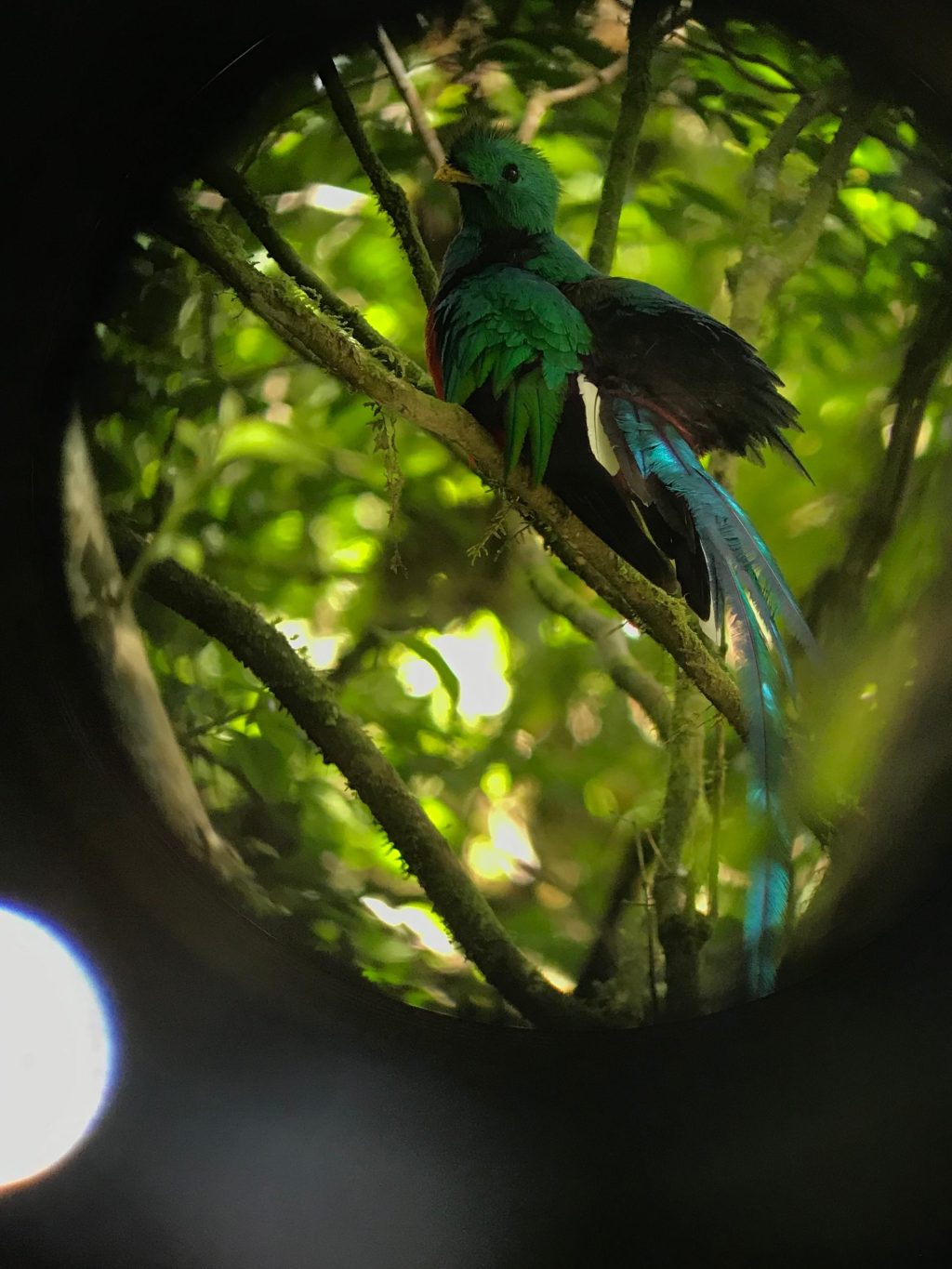
“Ah, there, look. Look!” My guide expressed his genuine excitement to me, the student closest to him, as he gestured to his mounted telescope. I curiously held my eye to the lens and focused on a figure over 200 yards away perched on a curving vine amongst the tropical foliage.
The bird which took shape was a Resplendent Quetzal (Pharomachrus mocinno), a medium-sized bird resplendent in brilliant green feathers, a bright red breast, with a swirling wispy tail longer than the length of its body. Evidently, this sort of bird is a rare sight in the Monteverde mountains of Costa Rica and I relished the somewhat blurry sight of this bird by taking a picture with my phone through the sight of the telescope.
It was a male and my guide explained that he was likely sitting near his nest where his female companion was resting on their egg. Of the two sexes, the male is the more colorful, making it easier to spot, and yet it was still hard to see amongst the equally bright green underbrush.
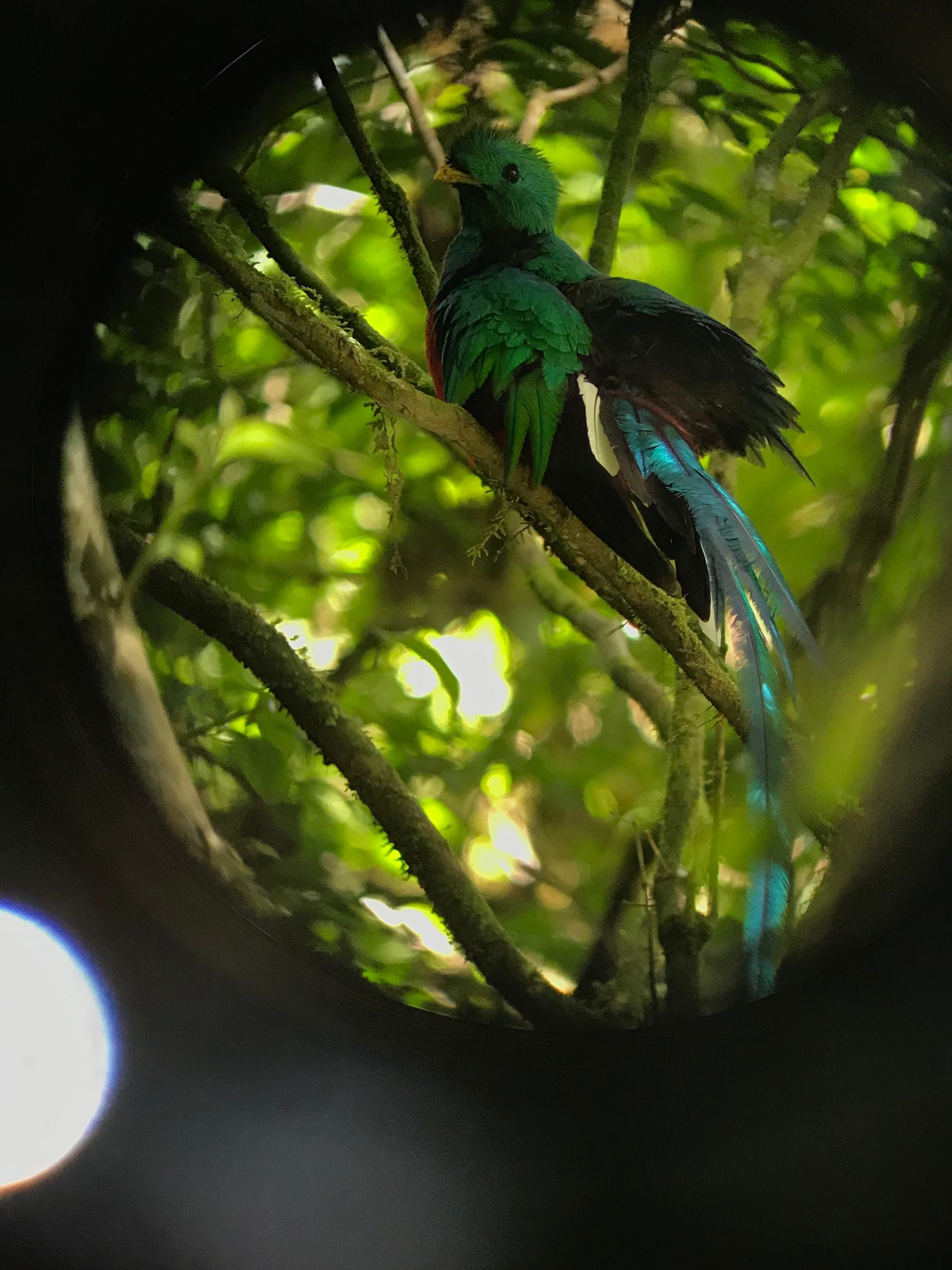
Through the ages, the Quetzal has been as revered as much as it is secretive. Sightings of the bird are somewhat uncommon as only about 50,000 of the bird at most still exist in the wild. This number is on steady decline with the status of the species at Near Threatened. Their span primarily covers Central America, stretching from Mexico to Panama. They prefer the higher elevations of montane cloud forests, their migration occurring altitudinally over the year as they search for their favorite food; avocado fruit.
Aztecs, Mayans, and other Mesoamerican cultures consider the bird sacred, associating it with a god known as Quetzalcoatl in Aztec (also Kukulkan in Mayan.) Quetzalcoatl is a multi-faceted god portrayed as a feathered serpent and known as a creator of the universe among their other less-prominent abilities such as controlling the weather and warfare.
Their bright red underbelly stands in stark contrast with their green outer feathers, a trait developed due to sexual selection in males by females. Guatemalan lore contends that they received this coloration when a Quetzal landed upon the bleeding chest of a dying noble warrior of the Quiché Maya, Tecún Umán, after a heroic attempt to defend his people against the Spanish Conquistadores.
Interestingly, many beliefs around the Quetzal are centered on a sense of freedom and ancestral pride. Today, Guatemalan currency is named after the Quetzal and it is established as their national bird. Similarly to the theme of the tale of Tecún Umán, there is another story of how the Quetzal once had a beautiful song but vowed never to sing it again until the land was free from the Spanish. A common belief is that Quetzals would die of a broken heart if it were to be kept in captivity, unable to be free.
Because of their revered nature, it was a crime punishable by death to kill a Quetzal. They were resultingly handled with great care when brieflyvcaptured for their vibrant and long plumage (known to get almost a meter in length) which adorned the headdresses of Mesoamerican rulers. Even today, despite their conservation status being only Near Threatened, countries like Costa Rica are striving to protect the species and their habitat. It is also frowned upon to hold one in captivity. While they do not die as the old belief says, they do not do as well as they would in their natural habitat. Moreover, it is contrary to their representation of freedom.
It is an unsurprisingly common occurrence for human populations across the globe to regard an animal as beautiful and graceful as the Quetzal as a divine being. It’s round black eyes maintain a sense of innocence as they glisten in the light of every photo. From its slight yellow beak to its elegant rounded wings, everything about this bird is close to ethereal, particularly as it glides in and out of sight through the jungle canopy. No matter how much we learn of the world, we will always be in awe of those which are so unlike us.
But why do we feel so strongly for the Quetzal? It hasn’t provided any important resources to us, let alone any services. The species has never even liked humans, choosing to reside in isolated regions away from us, and yet we assign so many values to it.
The answer may be that its presence awakens in us a sense of wonder that can be so addictive. Unlike other animal symbolisms tied to nations, such as the Bald Eagle, Quetzals are identified as being peaceful and almost delicate. They are creatures whose small bodies gliding gracefully through the air, long iridescent green tail feathers trailing behind as if moving it by magic, remind us of the equally fleeting feeling we have as we overlook the natural world in peaceful silence. Remaining just out of reach, unwilling to come, it reminds us that we can never keep it for ourselves. It is an humbling wonder.
 Wild Natura